Rogue Convergence
Demography, debt, technology, inequality: four ordinary trends are about to cross. Three futures for 2035, and six objects to build now.
Yann Rousselot-Pailley ·
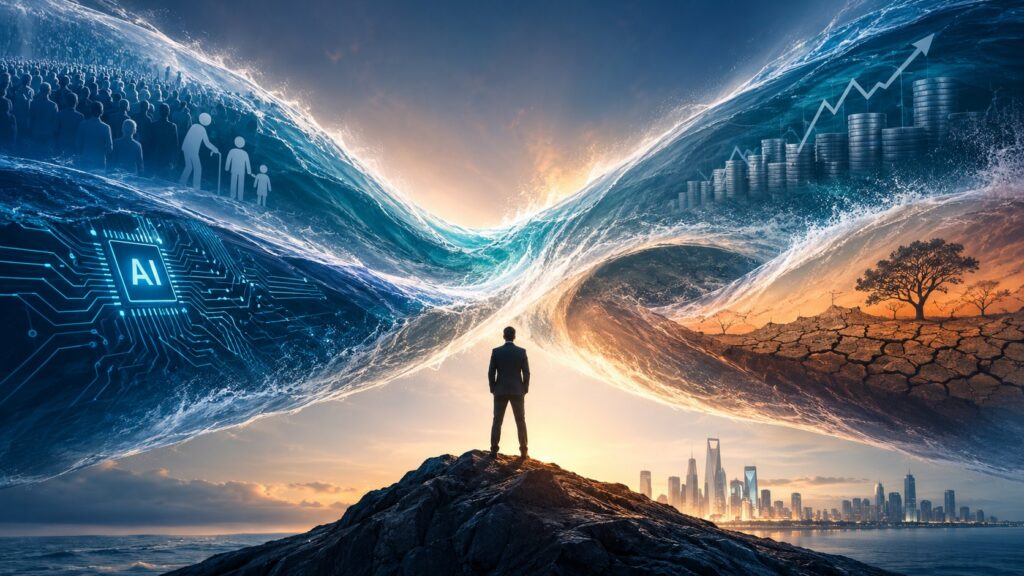
On New Year’s Day 1995, a storm hit the North Sea. Around the Draupner gas platform, off Norway, the waves were about twelve metres high. Then one wave rose to 25.6 metres. Sailors call it a rogue wave. The experts of the time said it was almost impossible.
Years later, scientists recreated the wave in a test tank. The cause was simple. Alone, a wave breaks before it grows that tall. But two groups of normal waves crossed at a wide angle. The crossing lifted the limit. No monster. Just an unfortunate series of circumstances.
In the same way, we are about to be hit by an immense social rogue wave. My aim with this article is to give you the means to prepare for it, or even to surf it.
We watch the waves one at a time
Governments track big trends the way we tracked waves before Draupner: one at a time. Demography has its ministry. Debt has another. So does AI. So does climate. Each file is well managed. But nobody is asked what happens when everything hits at once.
The Canadian researcher Thomas Homer-Dixon calls this “synchronous failure”. I call the version we are living through Rogue Convergence: four trends, each manageable alone, that cross and amplify one another. The danger is not in the waves. It is in their interaction.
Four waves
Demography. According to the United Nations, 63 countries have already passed their population peak, including China, Germany, Japan and Russia. They will lose about 14 per cent of their people in thirty years. Fewer workers will carry more retirees.
Debt. The IMF expects global public debt to reach 100 per cent of GDP in 2029, a level last seen after the Second World War. In one year, advanced economies paid more than 3.3 trillion dollars in interest. That is more than the world spends on defence. Debt is a bet on tomorrow’s workers. There will be fewer of them.
Technology. The IMF estimates that 40 per cent of jobs worldwide are exposed to AI, and 60 per cent in rich countries. Exposed does not mean eliminated. The real risk is not mass unemployment. It is the loss of the first rung: a Harvard study found 9 per cent less junior hiring at companies that adopt generative AI. And value has left the factory. In 1975, intangibles made up 17 per cent of the value of the S&P 500. Today, 92 per cent. Yet our tax systems tax salaries, not code.
Inequality. The richest 10 per cent own 75 per cent of the world’s wealth. The poorest half own 2 per cent. When AI creates wealth, it goes first to those who own the technology.
Climate blows on all four. The International Labour Organization expects heat to wipe out the equivalent of 80 million full-time jobs by 2030, mostly in the youngest regions of the world.
Together, these waves break a simple promise: study, start at the bottom, work hard, and you will move up.
Three futures for 2035
Foresight does not predict. Michel Godet, a leading figure of the French school of foresight, taught a simple rule: the heavy trends are the same for everyone. What changes is how the actors respond. Let us vary that response and look at what we find in each future. A payslip. A contract. A passport. These objects are called artifacts from the future. They are imagined. The waves behind them are not.
| Scenario | States | AI | The young |
|---|---|---|---|
| The Vise | endure | removes the first rung | drop out |
| The Centaur Pact | redesign taxes | works in pairs | steer the machines |
| The Scramble for Hands | fight over talent | robots still too few | raise their price |
The Vise. Every ministry stays in its lane. Debt and pensions lock up public budgets. AI removes junior jobs, in the offices of the North and in the call centres of the South, where heat already shortens the working day. Taxes still rest on salaries that are melting away. Public schools and hospitals grow poorer. The artifacts: a payslip where the largest deduction funds pensions the worker does not expect to receive. A rental listing that asks for proof of assets, not a job contract.
The Centaur Pact. With their backs to the wall, some states change the rules. Taxes follow income to where it now arises: with those who own the machines and the data. AI enters hospitals and public administration, and ageing costs less. The first job is protected: every beginner works in a pair with AI agents, steering and checking them. The artifacts: a tax return where the line “returns from machines” is larger than the line “salaries”. An apprenticeship contract titled “AI agent auditor, dawn shift, 5 to 11 a.m.”
The Scramble for Hands. Since 2030, AI has been leaving the screen and entering robots. But there are still too few of them. Software cannot care for an eighty-five-year-old patient. It cannot repair a power grid in a heatwave. The world no longer lacks jobs. It lacks hands. Young people skilled in physical trades become the rarest resource on the planet, and ageing countries fight over them. The artifacts: a work passport that offers ten tax-free years to anyone under thirty. A payslip where an air-conditioning technician earns three times more than a financial analyst.
Three opposite worlds, one pivot. In all three, the same objects come back: the payslip, the first contract, the tax return. Those are the ones to watch.
Who takes the wave first?
Here I side with Peter Turchin and the Russian school. Turchin described the mechanism: too many graduates for too few places, and trust breaks. As early as 2010, he announced the turmoil of the 2020s. Leonid Grinin and Andrey Korotayev give the date: the technological shift will play out in the 2030s and 2040s.
Here is my anticipation. The wave will hit the West first, because change moves fastest there. It will also hit the countries that live in its orbit or under its pressure: Korea, Japan, Thailand, Iran. The signs are here. Korea has the highest robot density in the world, and 680,000 young people who have stopped looking for work. Iran is ageing faster than almost any other country.
The countries of Asia and the Middle East that reduce their dependence on the West, or turn toward India and China, will have more time and more means to adapt. India brings the hands. China brings the machines: 59 per cent of the industrial robots installed worldwide in 2025. This pivot will not be smooth. No empire lets itself be undone without a fight, directly or by proxy. The artifacts to watch: a gas contract settled in yuan. A severed undersea cable.
Then comes the speed of decision. To hold on, some democracies will hand more power to strong executives, for a time. The retreat has begun: according to the V-Dem Institute, 74 per cent of humanity lives under autocratic rule. The artifact to watch: an emergency law. Check whether it carries an end date.
Seen from the Gulf, the equation is different. Decision chains are short. Sovereign funds manage about 5.7 trillion dollars. Trade with Asia is already twice the trade with the West. The Gulf can choose its partners, and sign the Centaur Pact first. Two caveats. Speed amplifies good decisions and bad ones alike. And no country becomes sovereign in technology with talent it cannot retain.
2040: robots among us
The Scramble for Hands will not last. Shortage speeds up the robots. The signals are here. Yann LeCun left Meta to build AI that understands the physical world. Here is one possible future, in two steps. Its name: the Machine Rent. Yanis Varoufakis already describes a rent collected by platforms. This one moves to robots. Technology solves production, not sharing. It is uncomfortable. That is its use.
By 2040, tens of millions of robots work beside us. Each carries a small model. What one learns, all of them know within a second. What one gets wrong, all of them get wrong too.
On the way, Q-Day came: the day a quantum computer broke encryption. Some experts expect it as early as 2029. Crypto-assets were stolen on a massive scale. State secrets leaked. What people read sent them into the streets. In several countries, the technology giants used the chaos to take the place of governments. A resistance grew, strongest in northern Europe. It hijacked home and factory robots and turned them into spies, soldiers and allies. Its motto: data belongs to a human person.
The artifacts of 2040: a dismissal letter, attached to the productivity record of the robot replacing the employee. An incident report: one update, the same error, a hundred thousand robots at the same instant. A household robot with its tracking chip torn out.
2050: who is human?
Ten years later, there are more than a billion robots. That is Morgan Stanley’s forecast. They repair orbital stations. They mine the Moon and the asteroids. They do what our biology forbids.
The line around “human” has blurred. Children engineered before birth in the 2030s are now adults with abilities others cannot match. Some robots carry living neurons, harder to hack than code. Already today, one company sells a computer made of 200,000 human neurons.
The artifacts of 2050: a repair log from an orbital station, signed by a robot crew. A birth certificate with a line for “genetic upgrades”. A court ruling on whether a machine with living neurons is a person or a product.
Six objects to build now
Foresight also works in the other direction. We can imagine the objects of a future worth wanting and bring them into the present. Here are six.
- A convergence stress test at the top of every budget. It certifies that the text was tested against all four waves, together, by a small team at the centre of government. Singapore already ties its scenarios to its budget.
- A tax that follows value. The IMF’s managing director has asked the question: how do we tax when AI moves income from labour to capital? Not with a robot tax, which the IMF advises against. With a tax system that looks at where income arises, and who owns the machines.
- A human-AI apprenticeship contract in public procurement. The first job matters as much as a road. A company that trains young people to steer AI agents scores extra points.
- A rights passport in every phone. Pension, benefits and credentials follow the person, from one employer to the next, one trade to the next, one country to the next.
- A work contract indexed to the thermometer. Above the danger threshold, it switches to dawn hours, in the spirit of what the ILO recommends.
- An inalienable right to one’s data and neurons, recorded in the civil register and protected by post-quantum encryption. Encryption standards have existed since 2024. In 2025, UNESCO adopted a recommendation on the ethics of neurotechnology.
None of this needs a new ideology. It needs one shared picture of the future, held by ministries that rarely talk to each other.
The Draupner platform survived its wave. What changed afterwards was the science: researchers stopped studying waves one by one. The North Sea did not create a monster that day. It created ordinary waves that arrived at the same time.
Watch the crossings. And learn to surf.
Sources
- Draupner wave: ECMWF, What conditions led to the Draupner freak wave?; University of Oxford, laboratory recreation
- Synchronous failure: Homer-Dixon, T. et al. (2015), “Synchronous failure: the emerging causal architecture of global crisis,” Ecology and Society 20(3)
- Scenario method: Godet, M. and Durance, P. (2011), La prospective stratégique, Dunod
- Demography: UN DESA, World Population Prospects 2024 — Key Messages; AP via NBC, −14% over 30 years
- Public debt: IMF Fiscal Monitor April 2026, via Anadolu Agency; IIF via Khaleej Times (interest vs defence)
- AI and jobs: IMF, via CNBC; Harvard study, via InvestingLive; Georgieva on tax systems, via People Matters
- Intangibles: Ocean Tomo, 2025 Intangible Asset Market Value Study
- Inequality: World Inequality Report 2026, via bdnews24
- Heat stress: ILO, Working on a warmer planet (2019)
- Political regimes: V-Dem, Democracy Report 2026
- Gulf sovereign funds: Global SWF, via The National
- Physical AI: Built In, Yann LeCun and AMI Labs; Morgan Stanley, Humanoids: A $5 Trillion Market
- Q-Day and post-quantum standards: Forescout, Countdown to Q-Day; AI Weekly, NIST 2024 standards
- Living-cell computers: Cortical Labs CL1
- Tax and AI: IMF, Fiscal Policy Can Help Broaden the Gains of AI to Humanity (2024)
- Neurotechnology: UNESCO, Recommendation on the Ethics of Neurotechnology (November 2025)
- Cliodynamics and the Russian school: Turchin, interview on End Times; Grinin and Korotayev, the sixth Kondratieff wave and global ageing
- Korea: robot density, Korea Times; 680,000 young people “just resting”, Asia Economy
- Iran: speed of ageing, Ageing International
- Robots in China: IFR, World Robotics 2026
- Gulf-Asia trade: Asia House, via Arabian Business
- Foresight in Singapore: Policy Options
- Platform rent: Varoufakis, Technofeudalism
How Innovation-Ready Is Your Organization?
Take the free Innovation Maturity Diagnostic — twelve questions across six pillars, built on thirty years of field research. Five minutes, and a personalised report at the end.
Take the Diagnostic →