When I first brought the first robot vacuum home, I couldn’t help but watch as it worked.
It wasn’t about technology alone.
It was the way in which it moved,—intentionally, and more efficiently.
It remembered the floor plan of our apartment.
It bypassed obstructions.
It was no longer seen.
Even the cat adapted, becoming a personal taxi to give a tour of the living room.
That scene can appear modern. However, it is a part of a tradition that began over two millennia ago in the invention of self-opening temple gates, animated puppets, and steam- and weight-driven singing birds—the first robots.
The ancient wonders didn’t compute or adjust, but they symbolized the same urge: The human desire is to transfer workload to engineered mechanisms and enable mechanisms to do the work for us.
That interest has fascinated me for years—perhaps because, as a child, I went from shaping stationary wooden pieces to crafting electronic entities that moved, reacted, and responded.
Nowadays, robots don’t only move, they also learn. In doing so, they change not just what machines can accomplish but also the way we engage with decision-making.
The result? The gradual but deep change in what we outsource, what we trust, and what no longer second-guess.
1. From Automation to Contextual Learning
They had previously been restricted to controlled environments, performing pre-programmed, routine tasks. Industrial robotics, developed in the 20th century under the logic of Taylorism, was a matter of efficiency, not of adapting.
Then came the turning point with the arrival of AI: the robots began to learn. Rather than doing, they simplify. Rather than being programmed, they acquire knowledge independently under predetermined parameters.
That is no longer automation. This is a step toward autonomous systems aware of their environment—a direction pioneered in early adaptive control theory and now in the spotlight of robotics and AI developments (Sutton & Barto, 2018).
2. From Static to Dynamic Affordances
In cognitive ergonomics, affordances refer to the potential action of an object, as proposed by Gibson (1979) and developed by Norman (1988).
Older technology had static affordances—levers, buttons, and graphical instructions. AI-equipped robots now allow for dynamic affordances: They modify their “recommended functions” in real-time based on the activity of users, environmental inputs, as well as previous interactions.
It revolutionizes the role of human. In place of issuing commands, we react to the machine’s suggested recommendations—a role reversal of profound human-robot interactive implications (Dautenhahn, 2007).
3. Towards Self-Sustaining Systems
Autopoietic theory, developed by Maturana and Varela (1972), defines systems as able to reproduce and maintain their own organization. Robots had been of the allopoietic domain—constructed, but by no means self-constructing.
With machine learning, particularly model adaptation in real time and reinforcement learning, we are heading toward operational autopoiesis in robotics. These systems evolve internally, sometimes independently of human control, which raises new challenges in control and design as a problem of governance and ethics (Floridi et al., 2018).
This does not make them “alive,” but it does make them increasingly less transparent in their decision-making, and hence less predictable or auditable.
4. Low Utility, High Societal Impact
Not all technology is notable due to its utility. They become transformative through their cultural context.
The robot vacuum does not solve a huge social problem. And offers—unobtrusively—a cognitive redefinition of acceptable delegation. It teaches that machines can handle decisions that you do not need to monitor. And that matters.
As Zuboff (2019) highlights in The Age of Surveillance Capitalism, small conveniences tend to pave the way for more profound systemic change in control, trust, and behavioral conditioning.
We do not give up control in one moment. We give it up, piecemeal.
The Era of Static Symbols Is Over
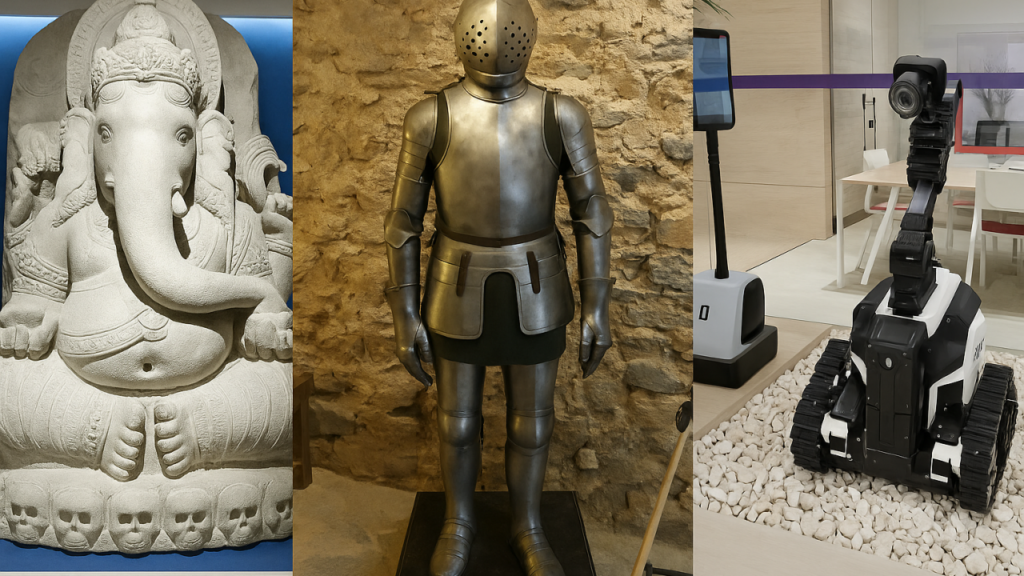
They also had ancient human-like statues—symbolic or religious—and they were constructed to depict power, protection, or ideal form. They remained icons of human hope. I wished to cut those shapes from wood when I was a child. And then along came electronics—and learned how to make things move, sense, and respond.
Today, the humanoids are no longer stationary. They communicate, adjust, and eventually learn from and about us. This movement from representation to cognition is technical, but it’s more than that. It’s anthropological. It challenges what we build as well as what we project onto what we build.
Robots are no longer a metaphor anymore. They are a mirror—steadfastly reflecting the delegation choices that we make, and the agency that we permit to slip away.
How Innovation-Ready Is Your Organization?
Take the free Innovation Maturity Diagnostic — a 3-minute self-assessment based on 30 years of field research across 50+ countries.
Take the Diagnostic →More from Innovation Mastered